Vape case: carrying your kit without damage
A screen scratched by a keyring, a tank leaking at the bottom of a bag, a glass section cracked after a fall of half a metre. Vaping hardware copes badly with being carried loose, and yet it spends its days doing exactly that in a pocket. A vape case costs less than a replacement tank, but you still have to pick the right kind of protection.
What a vape case actually does
A vape case is a container, soft or rigid, meant to isolate your hardware from knocks, scratches and metal contact while you move around. It also gathers up the accessories that go with it.
Its function goes well beyond appearances. It prevents the fire button being pressed accidentally at the bottom of a pocket, it contains any e-liquid leak, and above all it lets you carry spare cells without leaving them against conducting objects.
That last point is the one that turns a convenience into a safety matter, and it is the reason this accessory deserves more thought than its shelf position suggests.
The four families of case on British shelves
Shop vocabulary happily mixes skin, pouch, case and bag. Behind those words there are really four solutions with very different uses. The right choice depends mostly on what you carry and how often you move.
The silicone skin, often listed as a skin or sleeve, hugs the exact shape of one specific mod and stays on permanently. It absorbs everyday micro knocks and adds a non slip grip. Its downside is incompatibility: a skin is almost always drawn for a single model, so change your mod and it becomes useless.
The zip pouch is the most versatile format. It gathers the mod, one or two bottles, spare coils and sometimes a screwdriver. Semi rigid models in neoprene or moulded EVA offer the best compromise between volume and protection, and it is the format to favour as soon as you carry more than the device alone.
The lanyard is a cord with a silicone ring that keeps a compact pod within reach without using a pocket. Handy outdoors, it offers no impact protection whatsoever.
The hard shell, a plastic or aluminium box with cut foam inside, is the answer for fragile hardware and long journeys. Bulky in daily use, it earns its place as soon as luggage is involved.
Sizing a vape case to your hardware
A case that is too big lets the contents knock about, one that is too tight strains the zip. Measure your hardware assembled, tank included, before ordering online.
For a pocket pod, a simple soft sleeve or a slim pouch is enough. For a single cell mod with a tank fitted, allow a pouch of around 15 cm in length with a separate compartment for bottles.
For a dual cell mod, look at a bag format with retaining elastics. Bulky hardware shifts around inside a badly matched container, and that movement is precisely what breaks the glass section of a tank.
British kit is helpfully consistent on one point: tanks are capped at 2 ml, so even a large sub ohm setup stays reasonably short. What varies is bottle count, since nicotine containing e-liquid is sold here in 10 ml bottles, and a day out often means carrying two or three rather than one large one. Compartment count matters more than overall volume.
Carrying cells: the rule with no exceptions
Here is where a case stops being a comfort. A bare lithium cell in contact with keys, coins or another cell can short circuit.
The consequence is an abrupt rise in battery temperature, with a risk of venting. This is not a theoretical scenario: it is exactly why every serious British retailer sells plastic transport cases for pennies alongside the cells themselves.
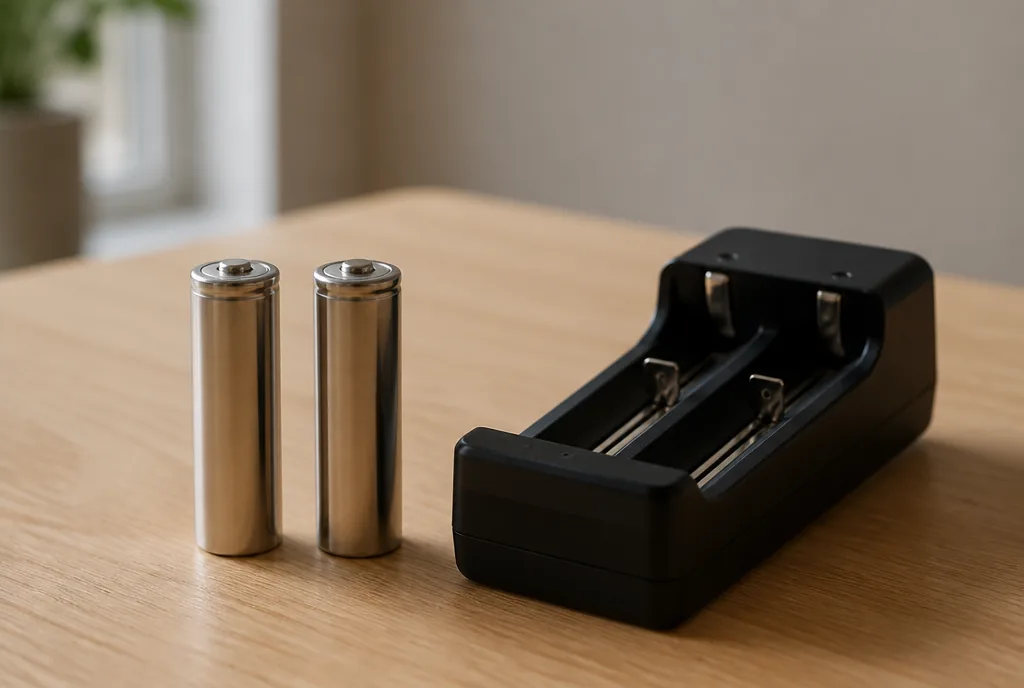
The rule is simple and admits no exception. A cell that is not inside a device goes in a dedicated case, never loose, and certainly not sitting in the cradle of the battery charger, which is not a transport container. Check the wrap too, the coloured plastic sleeve around the cell. A torn wrap exposes the metal body and must be redone before the cell travels anywhere.
Flying with your vape
Airlines apply strict rules inherited from lithium battery regulation. They are consistent on the essentials, with variations between carriers on the details, so the operator’s own page is always worth a look before departure.
The general principle is that the device and its cells travel in the cabin, never in the hold. Carriers commonly accept vaping devices in the cabin without declaration provided the battery stays under 100 Wh, and ask that spare batteries be protected against short circuits.
Three habits complete the picture. Switch the device off or remove the cell before boarding, put your bottles in the transparent liquids bag within the permitted format, and remember that vaping on board is prohibited on every flight. A compartmented case makes security noticeably quicker, since everything presents as one block.
Leather, neoprene or hard shell: how each ages
The price of a case follows its material first. Each one has a predictable wear profile, useful to know before you commit.
Neoprene cushions well, resists damp and costs little, but it loses its shape after a few months of heavy use. Moulded EVA keeps its form durably and protects glass better, at the cost of more bulk. Real leather ages nicely and lasts years, with a genuine sensitivity to e-liquid stains that need wiping immediately. Faux leather gives the look cheaply, but the stitching and coating break down faster.
One detail worth checking whatever the material: a soft inner lining. Without it, the zip eventually scratches the screen of the mod, and no amount of care prevents it.
Frequently asked questions
Does a case protect against an e-liquid leak?
It contains the leak and stops it soaking into a bag, but it does not prevent it. Always store hardware with the tank uppermost, and keep bottles in a separate compartment.
Can a vape be left in a car in summer?
Best avoided. The temperature inside a closed car in the sun goes well beyond the recommended operating range for lithium batteries. Take the hardware with you.
Are there cases that lock?
A few hard shells offer a lock or a combination padlock. It is the solution chosen by households wanting to keep hardware out of reach indoors, which matters where under-18s are present.
How do you clean a case that smells of e-liquid?
Empty it, wipe the inside with a damp cloth and a little mild soap, then leave it open to air for twenty four hours. Keep it away from any direct heat source.
Does a rebuildable setup need a different case?
A model with separate compartments is preferable, since you are also carrying wire, cotton and tools. A gusseted roll or pouch fills that role well.
A case that fits means hardware that lasts
The reasoning comes down to three questions: what are you carrying, over what distance, and with which spare cells. A pod alone is happy in a soft sleeve, a dual cell mod wants a compartmented bag, and every cell outside a device needs its own plastic box.
Choosing a vape case that matches your actual use means protecting an investment considerably larger than the price of the protection itself. It is also what marks out a setup that has been thought through, right down to the mouthpiece and its material, and the rest of the cases and carrying section takes the same view.
Editorial content for adult readers only. Vaping products usually contain nicotine, a substance that causes addiction. Not for sale to under-18s in the United Kingdom. This article is not a buying recommendation.