Drip tip material: which one to pick and why
Two mouthpieces with rigorously identical measurements can give two completely different vapes. At equal geometry, everything comes down to what the part is made from: heat conduction, durability, neutrality in the mouth, resistance to a drop. British shops list the drip tip material the way they list a colour option, when it is in fact the technical choice with the heaviest consequences.
What really separates one mouthpiece from another
Composition governs two properties nothing else compensates for: the speed at which the mouthpiece passes heat to your lips, and whether it holds on to the flavour of previous e-liquids.
Technical plastics insulate and stay lukewarm in all circumstances. Metals conduct and climb in temperature with the atomiser. Glass is neutral but fragile. Everything else, colour, pattern, finish, is aesthetic and has no bearing on the vape at all.
That distinction matters more in Britain than it first appears. With tanks capped at 2 ml, refills are frequent, the mouthpiece comes off often, and a part that scratches, dulls or cracks under handling shows its weaknesses quickly.
Technical plastics: Delrin, PTFE and Ultem
This is the best represented family on the British market, for a simple reason: it offers the best compromise between thermal insulation, mechanical durability and price. The three industrial materials behave similarly in use, with differences that count.
Delrin is the trade name of a polyoxymethylene, a dense plastic recognisable by its matt black finish and slightly silky feel. It insulates very well, so the mouthpiece stays temperate even when the tank is hot. It scratches over time and does not take bright colours, but it shrugs off drops. That is the default choice when you would rather not think about it.
PTFE, often sold as Teflon, has an ivory white translucent look and thermal behaviour very close to Delrin. Its non stick surface limits condensation building up in the channel. Its weakness is mechanical: the material is soft and deforms if you force it into place, so a gentle push is plenty.
Ultem, or polyetherimide, is identifiable by its amber translucent tint. Its heat resistance is markedly better than the other two, which makes it the reference drip tip material on low resistance, high power atomisers. It is also stiffer and dearer, and on a quiet mouth to lung setup the outlay is not justified.
Epoxy resin: looks at the cost of fragility
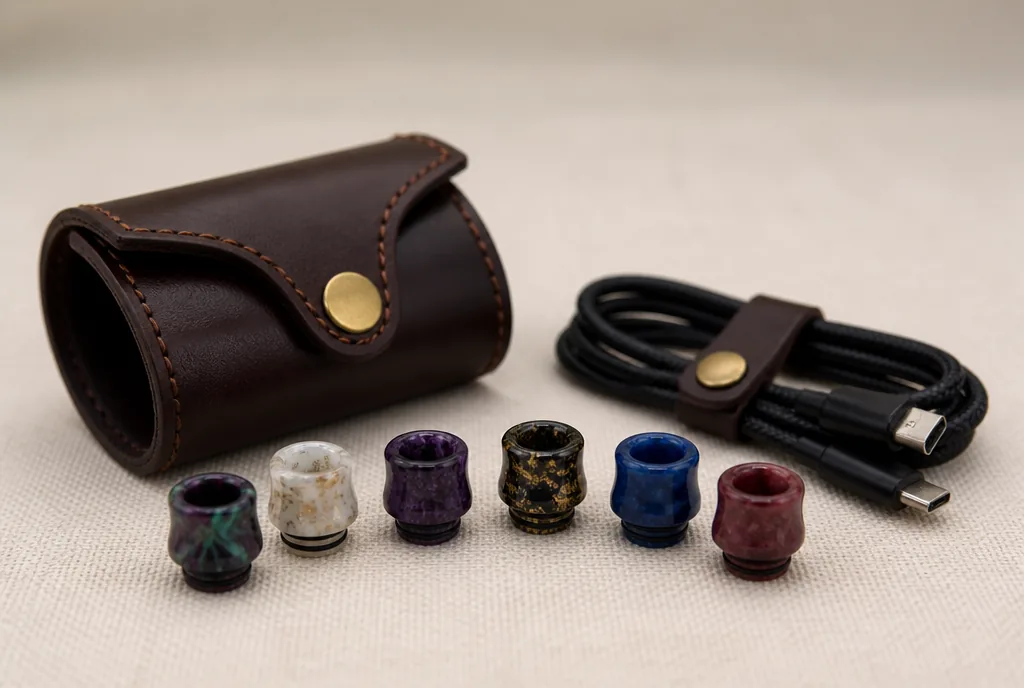
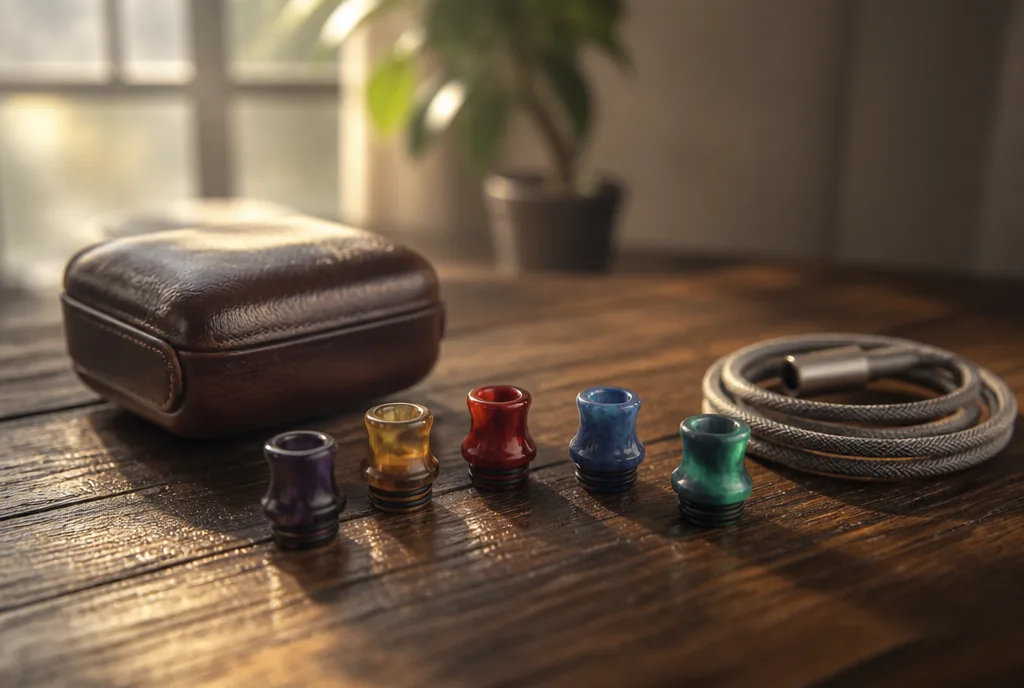
This is the material that fills the display cases, with coloured veining no two examples of which are alike. Resin is cast in blocks around pigments, then turned on a machine.
Thermally it sits between the technical plastics and metal, holding up acceptably to heat. Its real weakness is impact: a resin mouthpiece dropped on a tiled floor chips or splits, where a Delrin one bounces.
The second point to watch is the tint. Pale resins dull under UV and under certain heavily flavoured e-liquids. Nothing irreversible, but the mouthpiece loses its main purpose, which was to look good.
Metal, glass and ceramic: the conducting group
These three families share one characteristic: they transmit heat rather than insulating against it. That is a drawback on a powerful build, and an advantage when you want to cool vapour along the length of the channel.
Stainless steel is the dominant metal. Robust, finely machinable and indifferent to e-liquid, it becomes distinctly hot on a sub ohm build, which explains the popularity of hybrid models pairing a steel base with a resin or Ultem mouth section.
Borosilicate glass is absolutely neutral in taste and keeps no trace of the previous e-liquid, which makes it the pick for vapers who change flavour often. Its fragility on the move remains a deal breaker for many.
Ceramic is rare and costly. It combines neutrality with good heat dissipation, but it stays marginal in British catalogues, where it belongs more to the collector shelf than to daily use.
Silicone, the budget drip tip material that earns its place
Sold for very little in British shops, the silicone mouthpiece occupies a niche nobody disputes. Soft and unbreakable, it does not scratch and gets replaced without a second thought.
Two uses justify it fully. The first is transport, where a soft mouthpiece protects the top of the tank from knocks. The second is the occasional sharing of hardware, where a dedicated mouthpiece settles the hygiene question without discussion.
Its limit is taste. Cheap silicone can give a faint plastic note for the first few days. A rinse in hot water before first use reduces the effect noticeably. Where it goes afterwards is a question of storage, and the carry case usually answers it.
Cleaning and replacing your mouthpieces
The mouthpiece is the most exposed part of the build and the least maintained. A regular pass is enough to avoid a clogged channel and the sugary deposit that dulls flavour.
One method suits every material. Take the mouthpiece off, run it under warm water with the channel pointing down to flush residue out, then use a single drop of washing up liquid for a deeper clean, rinsing thoroughly. Dry with a cloth before refitting.
Some things are best avoided. Boiling water deforms PTFE and weakens resin. Surgical spirit dulls coloured resins and attacks some finishes. The dishwasher is out of the question for every material without exception.
Three signs mean the part is done: a marked channel, a seal that no longer holds, or a fine crack in a resin. Given what mouthpieces cost, keeping a damaged one makes no sense, and the measurements to respect when ordering a replacement are set out in our guide to choosing a drip tip.
Frequently asked questions
Can a mouthpiece be painted or varnished to change its colour?
It is strongly discouraged. High street paints and varnishes are not designed for prolonged contact with the mouth, nor for the heat coming off an atomiser.
Is stabilised wood usable for a vape mouthpiece?
It turns up on artisan pieces, where the wood is vacuum impregnated with resin. Durability depends entirely on the quality of that stabilisation, which varies a great deal from one maker to another.
Does one material give better flavour than another?
Glass and the technical plastics are the most neutral. A low grade resin or a bargain silicone can add a parasitic note for the first few days.
How many mouthpieces should you own?
Two is enough in practice: the one fitted and a spare in the pouch. A third, different profile lets you experiment without stripping the main setup.
Are 3D printed mouthpieces any good?
The process leaves ridges that trap residue, and common filaments are not intended for hot contact with food or the mouth. Fine as a mock-up, not for use.
Matching the drip tip material to the way you vape
The rule condenses quickly. On a build that runs hot, take a technical plastic or Ultem. On a quiet vape, anything works and looks can decide. For anything carried around, rule out glass and pale resin in favour of something that takes a knock.
Keeping two or three mouthpieces in different compositions to hand costs very little and lets you adjust comfort day by day, season after season. Choosing the drip tip material deliberately, rather than by colour, is the cheapest upgrade available on a setup, and the rest of the small accessories section follows exactly the same reasoning.
Editorial content for adult readers only. Vaping products usually contain nicotine, a substance that causes addiction. Not for sale to under-18s in the United Kingdom. This article is not a buying recommendation.