Vape battery charger: bays, format and travel
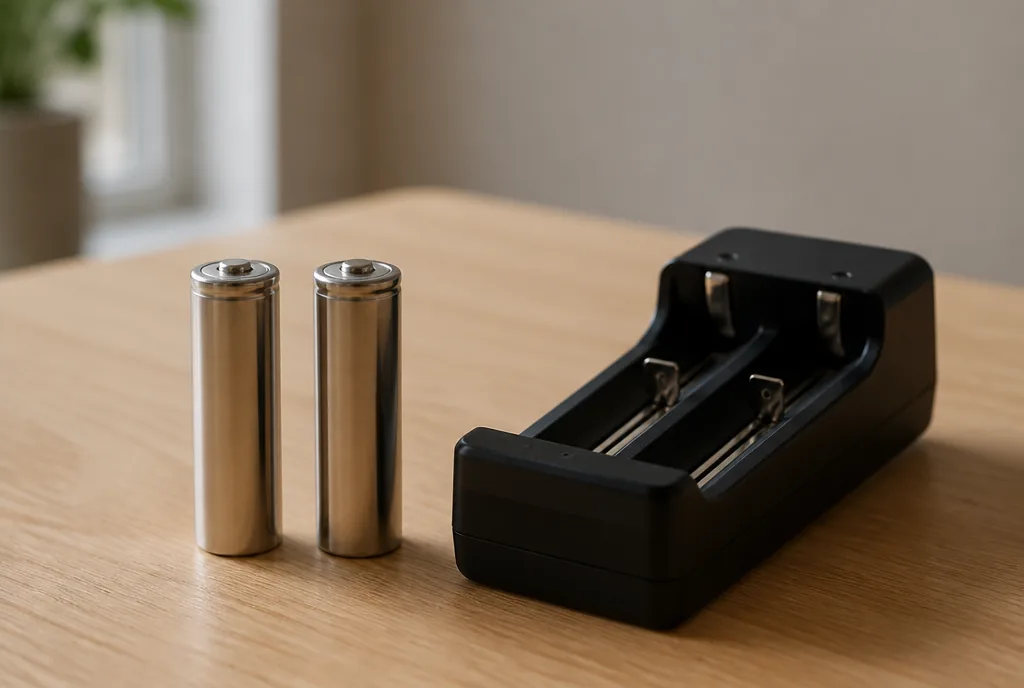
Fifteen listings on a British shop page look identical. The same black casing, the same declared cell formats, and nothing at all to tell you which one fits in a travel pouch, which will live plugged in behind a shelf, and which ends up forgotten in a drawer. A vape battery charger is an accessory like any other. It takes up room, it needs a socket, and it either travels with you or it stays at home.
A vape battery charger is chosen by its number of bays
The bay count, sometimes called slots, decides everything else: the size of the casing, the kind of power supply it needs, and the place the object will occupy in your home. Screens, test functions and colour options all come afterwards.
A single bay unit fits in the corner of a pouch. A four bay model covers the footprint of a phone lying flat and wants a socket of its own. Those are two different objects, not two versions of the same one.
British retailers stock both ends of that range side by side, from Xtar, Efest, Nitecore, Vapcell and Gyrfalcon among others, which is exactly why the listings blur together. The differentiator is not the brand badge, it is how many cells the unit holds at once.
What the bay count really changes
Product pages publish charging currents without always explaining how those currents are shared. That is where two units at a similar price actually diverge, and it takes ten seconds to read once you know what to look for.
Single bay models accept a wide span of cylindrical cells and draw their power over a USB port. The body is barely longer than an 18650 itself, which is what makes it the format that travels. It slips in beside your bottles without claiming a whole compartment.
Two bay units cover the most common British case, the vaper running a pair of cells in a dual battery mod. The casing stays flat and pocketable. Watch the stated current, though: a charger rated at two amps often delivers one amp per bay when both are occupied, and only reaches its headline figure on a single cell.
Four bay units are a different proposition entirely. On classic examples such as the Nitecore i4, the total output is fixed and shared between the occupied bays, so four cells charge together but each one charges more slowly. That is a worktop object, not a bag object, and buying one expecting four times the speed is the most common misreading in the category.
USB or mains: where the vape battery charger will live
The power supply decides where the accessory ends up, and that call is better made before the order than after it.
USB-C models plug into whatever source you already own: a phone charger, a power bank, a laptop port. They add no extra mains block to a crowded socket, which matters in a flat where sockets are counted.
Models with an integrated mains plug occupy a socket permanently but depend on no third party adapter. That is the fixed station logic: plug it in once and stop thinking about it.
A third format exists and gets far less shelf space, the charger that doubles as a power bank. These units charge your cells and then hand that energy back out to a phone, which saves carrying two objects on a long day away.
Carrying a charger without thinking about it
Portability appears on no spec sheet, yet it usually decides whether the thing gets used. A charger that is too bulky stays at home, and the spare cell ends up travelling loose, which is the one outcome to avoid.
Three points settle it. Whether there is a lid or a closed bay, so a cell cannot work its way out of its cradle inside a bag. The thickness of the casing, which should stay under that of your mod so it does not deform a pouch. And the cable type, since USB-C is found everywhere while a proprietary connector is not.
Weight matters less than people expect. What gets in the way in a shoulder bag is the footprint, not the grams.
Charger, battery case and carry case: three different jobs
These three accessories are regularly confused in shops, and none of them replaces another. Telling them apart avoids both buying twice and forgetting the only one that counts.
A charger charges, and does nothing else. A cell that lives permanently in it is not stored, it is simply plugged in. A plastic battery case, sold for pennies, insulates a loose cell from any metal contact while it travels, and it is the piece that stops contact with keys or coins. A carry case holds the lot: the mod, the bottles, the coils and, if it fits, the charger and its cable, a subject covered in our guide to the vape case.
The rule for living with all three is simple. A cell outside the device travels in its own plastic case, never sitting in the charger, and the charger travels in the carry case like any other accessory.
Cell formats to check before ordering
Stated compatibility ranges are wide, but they do not always overlap with what you actually own. Checking takes seconds and saves a return.
General purpose units commonly cover everything from 10440 up to 26650, which takes in almost every cylindrical cell used in vaping, including the 18650, 20700 and 21700 that British mods are built around. Spring loaded cradles swallow those different lengths without an adapter.
The point worth checking is protected cells, which run a few millimetres longer because of their built in circuit. On a short cradle they go in under force, or not at all. Measure the real length of yours before ordering a compact model.
What British rules do and do not touch here
Hardware regulation in Britain lands on the tank and the liquid rather than on the charging accessory, which surprises people who expect the same rules everywhere on the shelf.
Refillable tanks sold here are capped at 2 ml, nicotine containing e-liquid at 20 mg/ml, and those bottles at 10 ml. None of that applies to a vape battery charger, which is why the charging aisle looks so much like the one in a torch shop.
What does apply is the age rule: vaping products are not for sale to under-18s in the United Kingdom, and that covers the accessories sold alongside them. Beyond that, a charger is judged on its own terms, and the rest of our chargers section works from the same starting point.
Frequently asked questions
Can cells be left permanently in a vape battery charger?
That is not what the unit is for. A charger is a stopping point rather than a storage place: take the cells out once charging is done and put them back in their plastic case.
Will it work with ordinary rechargeable batteries?
Some multi chemistry models say so explicitly, most do not. A charger built for lithium cells is not suited to NiMH, and the compatibility has to be stated in writing on the listing.
Do different cell brands need different chargers?
No. Cylindrical formats are standardised by dimension, so the same cradle takes a Samsung, Sony or Molicel cell of the same size without any difference.
What is the screen on some models actually for?
It reports charge state bay by bay, sometimes with voltage and current. On a model without one, indicator lights give a rougher version of the same information.
How do you clean the contacts?
A lightly damp cotton bud with the unit unplugged, then a full dry before any further use. Fingerprints and dust on the contact strips eventually interfere with the connection.
Choosing a charger as an accessory, not as an appliance
The question is not which unit charges best, it is where the unit is going to live. One bay for the travel pouch, two for the daily rotation of a dual battery mod, four for a fixed station shared between several devices.
Add the supply type to that, USB for mobility and mains for the desk corner, and the shortlist drops to two or three references. A well sized vape battery charger disappears into the routine, exactly like the other small objects that make a tidy setup work, and the rest of the cases and carrying section follows the same logic.
Editorial content for adult readers only. Vaping products usually contain nicotine, a substance that causes addiction. Not for sale to under-18s in the United Kingdom. This article is not a buying recommendation.