810 drip tip: wide bore, sizes and uses
The number comes from no industrial standard, no body ever registered it, and yet it appears on thousands of British listings. The 810 drip tip was born from usage rather than from a specification. The result is that the measurements travel from shop to shop with variable rounding, and the buyer ends up unsure what has been ordered. Time to put the millimetres back in order.
The 810 drip tip, the wide mouthpiece of airy atomisers
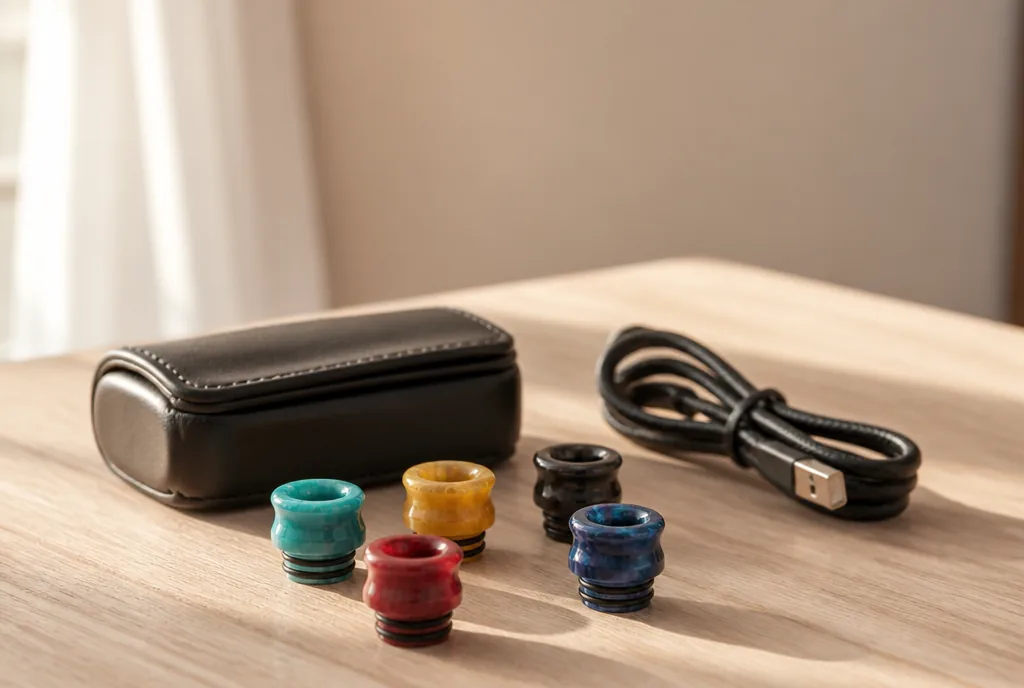
An 810 drip tip is a mouthpiece whose inserted base measures roughly 12.5 mm across, against 8.5 mm for the older fitting. Those four millimetres of difference change the purpose of the part completely.
The format was designed for atomisers moving a lot of air, the ones producing a large volume of vapour at higher power. You therefore find it almost exclusively on hardware meant for direct lung inhalation.
Two measurements identify an 810 with certainty, and a third explains why comfort varies so much between models. British retailers publish them unevenly, so it helps to know what you are looking for before opening a product page.
Reading the measurements that define the fitting
The base of roughly 12.5 mm is the reference figure, the one that has to match the seat in your atomiser. Specialist UK shops quote 12.5 mm, occasionally rounded down to 12 mm in a short description. As on any mouthpiece, the nominal value is measured without the seals; those are what take up the play and lock the part in place.
The internal bore of an 810 sits around 9 mm. That is close to double a classic mouth to lung channel, and it is precisely what buyers are after. The same wide section explains why an 810 does not transpose onto a tight setup: air moves through it without resistance, and the sense of draw disappears entirely.
The seals are often doubled. The weight and inertia of a wide mouthpiece call for a firmer hold, so many 810 models carry two sealing rings at the base rather than one.
810, 528 and Goon: three names for one fitting
This vocabulary muddle wastes everybody’s time. All three names describe the same base measurement, inherited from the atomisers that popularised it in the middle of the 2010s.
The Goon name comes from a dripper that became a reference in rebuilding circles, whose wide mouthpiece was copied at scale. The 528 refers to the maker of that dripper. The 810 label arrived later as a neutral commercial designation, helped along by the very wide distribution of large sub ohm tanks.
Remember simply that a mouthpiece sold under any of those three labels goes into the same seat. If you want the point of comparison with the other standard on the market, our guide to the 510 fitting and its measurements covers the other half of the table.
What a wide bore does to a direct lung draw
The logic is purely one of airflow. Doubling the cross section halves the speed of the flow at an equal volume, which produces three effects you notice on the first puff.
The vapour arrives cooler, because it is diluted in a larger volume of air. The draw becomes very loose, with no aspiration effort. And the aromatic impression spreads out: it gains in breadth and loses in definition compared with a narrow channel.
That is also what makes the fitting uncomfortable at low power. An 810 drip tip on a one ohm coil gives a hollow draw, with an impression of lukewarm, thin vapour that no amount of adjustment recovers.
The hardware that takes an 810 drip tip in Britain today
The format remains alive across the whole part of the market oriented towards vapour volume, even though compact pods have taken back a great deal of ground in British shops over recent years.
You find it first on large sub ohm tanks, a category where several makers installed the measurement as a de facto standard. Drippers and direct lung rebuildables use it too, often with a specific top cap supplied in the box.
Some manufacturers ship both bases in the kit, with an adapter allowing a step down to the narrow fitting. Check the box contents before buying an extra part you may already own.
One sign identifies hardware built for the wide fitting without opening the manual: the top of the tank has a flared seat, visibly deeper than a simple drilled hole. The mouthpiece sits several millimetres down into it rather than resting on the surface.
Where the wide fitting shows its limits
The format has real drawbacks that listings pass over in silence. Knowing them saves a small disappointment.
Bulk comes first. A mouthpiece 16 mm across at the top turns an already sizeable tank into something conspicuous and awkward to pocket. Then there is heat: the extended contact surface carries more warmth to the lips on metal materials, which makes the choice of composition matter more than it does on a narrow tip.
The wide channel also catches condensation. On a build generous with cotton, droplets regularly work their way up to the mouthpiece, something that barely happens on a tighter section. A quick wipe at the start of the day settles it, but it has to be remembered.
There is a running cost point that rarely gets mentioned. An airy draw uses noticeably more e-liquid and more battery than a tight one over the same period of use. In Britain, where nicotine containing e-liquid is capped at 20 mg/ml and sold in 10 ml bottles, direct lung vapers usually run much lower strengths and simply get through more liquid, so the bottle count climbs even though each bottle is small.
The 2 ml tank cap compounds it. A large sub ohm tank sold here holds the same 2 ml as a slim mouth to lung one, so a wide bore setup means refilling several times a day rather than once. That is the single most practical consequence of the rules for anyone moving to this style of hardware.
Last point, sharing gear. A wide mouthpiece suits some mouths far better than others, and the broad contact surface makes passing a device around less pleasant than a slim profile does.
Frequently asked questions
Can an 810 mouthpiece go on a pocket pod?
Rarely. Compact pods favour a narrow seat or a moulded mouthpiece, and there is simply no room for a 12.5 mm base. Check the specification of the model before buying.
What does 810 slim mean on some listings?
It describes a mouthpiece respecting the 810 base measurement but with a slimmer outer silhouette, for a less bulky feel on the lips. Compatibility is unchanged.
Does the fitting work with a 24 mm RDA top cap?
The diameter of the dripper has no direct bearing. Only the mouthpiece seat machined into the top cap matters, and that has to be checked with the maker.
Are there 810 mouthpieces in glass?
Yes, usually in borosilicate. They stay neutral in taste but do not survive drops, which limits their appeal for anything carried around.
Why does my mouthpiece come out with the top cap?
The mouthpiece seal is gripping harder than the top cap seal. Lightly moisten the mouthpiece seal, or replace the top cap seal, which has gone slack.
Choosing according to your atomiser, not the listing
The reasoning fits in a sentence: if your hardware is built for vapour volume and power, the 810 drip tip is the coherent fitting, provided you accept its bulk and the condensation that comes with it.
On a tight setup or a discreet pod, the exercise makes no sense and a narrower mouthpiece will serve your comfort better. As so often with vaping accessories, real use decides rather than the most flattering specification, and the same is true of the materials these tips are made from and of the carry case they end up living in.
Editorial content for adult readers only. Vaping products usually contain nicotine, a substance that causes addiction. Not for sale to under-18s in the United Kingdom. This article is not a buying recommendation.